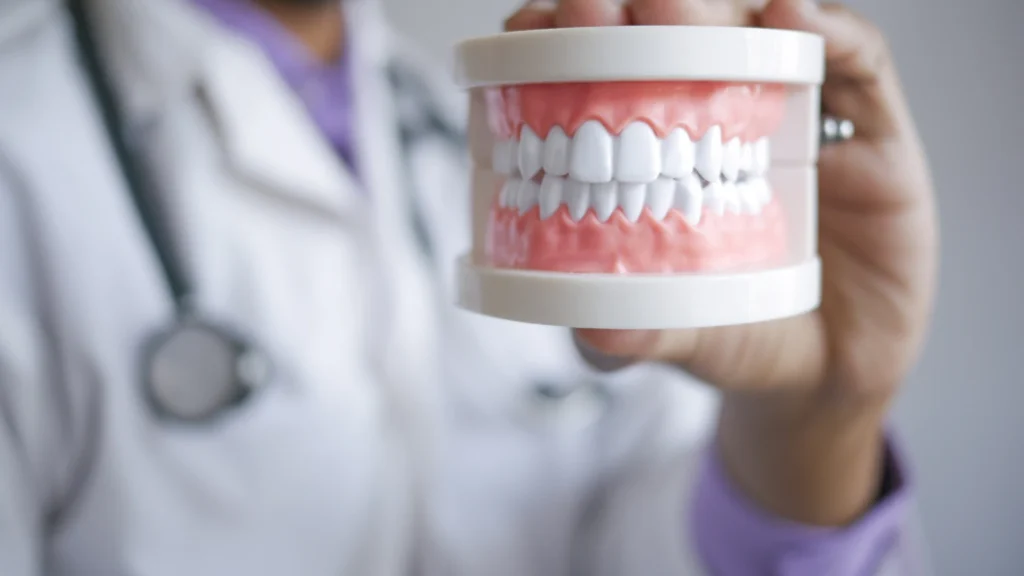
Different restorative solutions can offer strength or aesthetics, but the crown materials you use depend on the tooth location, how much tooth structure is present, how much force the tooth is under during function, and what aesthetics are present.
The material can also be affected by the rest of the tooth underneath the crown and whether the crown is being cemented or bonded.
Decisions like these are more than if E-max or zirconia is stronger. (strength and durability)
There is no one-stop answer to this question.
A better question is:
Which material offers the right blend of appearance, strength, and tooth preservation for this tooth?
A Quick Look At E-max vs Zirconia (Zirconia vs Emax)
| Feature | E-max | Zirconia |
|---|---|---|
| Material | Lithium disilicate glass-ceramic | Zirconium dioxide ceramic |
| Main Advantage | Translucency and natural appearance | High mechanical strength |
| Front Teeth | Frequently considered where appearance is a priority | Can be suitable, especially with more translucent zirconia |
| Back Teeth | May be suitable when the case and available thickness allow | Frequently considered for areas exposed to heavier forces |
| Dark Underlying Tooth | Translucency may allow the underlying colour to affect the result | More opaque types may mask dark tooth structure more effectively |
| Grinding | Requires careful assessment of bite forces | Strength can be useful, but bite management is still necessary |
| Bonding | Can be etched and adhesively bonded | Requires a different surface-treatment and cementation protocol (cement protocol) |
| Chipping and Fracture | Can fracture when forces exceed what the restoration can tolerate | Monolithic zirconia avoids a separate porcelain layer; layered designs can chip |
| Adjustment | Needs careful finishing to protect the ceramic | Requires careful polishing after adjustment |
| Repair or Removal | Depends on the type and extent of damage | Significant damage can be difficult to repair, and removal can be demanding |
| Best choice | Depends on the tooth and treatment goal | Depends on the tooth and treatment goal |
What the Comparison Table Means
E-max is a type of glass-ceramic that has a natural appearance and comes in varying degrees of translucency. It can be considered for either the front or back of the arch. Zirconia, on the other hand, comes in varying degrees of translucency and can also be used in both the front and back to some extent. Even though Zirconia can be used in posterior restorations, E-max would be a better choice since strength is not as important.
For teeth that have dark underlying tooth structures that tend to show through restorations, E-max may not be translucent enough to camouflage the underlying color. Zirconia would be more useful in these situations since it can be fabricated in more opaque shades.
Zirconia would be a better choice than E-max for restorations that come into contact with opposing teeth because of the increased strength Zirconia offers. Zirconia would be a better choice over E-max for restorations that would be subject to higher forces as required for the posterior teeth. Especially thin E-max restorations would be prone to chipping from opposing forces and stresses. Similarly to Zirconia restorations, E-max restorations would be required to have a well balanced occlusion.
E-max restorations can also be etched to create a bond. Both E-max and Zirconia can become toxic and release unhealthy byproducts during an intricate grinding process. A post-adjustment, protective layer of both material types would be required for restorations that come into contact with surrounding teeth.
Because of the process for removal of the restorations, repairing them would be more time consuming and cumbersome. E- max and Zirconia restorations would require the same level of intricacy for removal that more expensive all metal restorations would.
This comparison is only a starting point.
E-max and zirconia are material families rather than two identical products with fixed properties. (dental materials) Their material composition, translucency, strength, thickness and clinical use can vary.
E-max (E-max Crowns)
E-max is named after a type of lithium disilicate glass-ceramic. (IPS e.max, IPS Emax crowns, Emax lithium disilicate)
The glass-ceramic structure permits light to pass through, mimicking natural enamel. This is a large reason for the popularity of E-max. (IPS e.max)
Visibly, E-max looks great on teeth that have to have deep, translucent restorations, such as:
- Crowns
- Veneers (porcelain veneers)
- Inlays
- Onlays (inlays and onlays)
- Some implant restorations
This article is more about E-max crowns compared to zirconia crowns. E-max veneers, because of their differences in shape and size, require a more in-depth treatment and therefore should not be treated as full crowns.
Zirconia
Zirconia is a biocompatible ceramic made of zirconium dioxide.
Because of its strength, it is commonly used in crowns, dental bridges, long-span bridges, and implant-supported restorations. (crowns and bridges, porcelain-fused-to-metal alternatives)
Not all zirconia crowns are the same.
Monolithic zirconia
A full-contour monolithic crown is made primarily from solid zirconia.
The main drawback to this no-veneer structure is that, while it eliminates chipping of the outer surface layer, other problems may still occur.
Layered zirconia
Layered restorations refer to those that have a frame of zirconia with ceramic added on top.
The outer ceramic can be used to enhance the shade, translucency and surface texture of a restoration, although a separate layer may tend to chip under inappropriate stress.
Translucent Zirconia
Modern zirconia, including multilayer zirconia, comes in various levels of translucency in digital dentistry.
Zirconia crowns that aim to provide the greatest aesthetics should explain the type of zirconia and why it allows the technician more control in fabricating the final restoration in the smile zone.
In most situations, zirconia is a better choice than e-max.
When translucency is a priority, e-max is often a material of choice.
However, lithium disilicate is actually a better choice where translucency is necessary for a restoration that is visible. Lithium disilicate is better for creating one natural tooth that will adjoin many natural teeth. (natural dentition)
E-max is often a better choice for natural restorations when translucency is required.
But, zirconia can be used to create a natural tooth restoration, as long as modern layered translucent zirconia is used.
It can be difficult to predict the appearance of a dental crown, even with different types of ceramics. Factors affecting appearance can include:
- Opacity of ceramic
- Color of prepared tooth
- Ceramics and thickness selection
- Shade selection
- Texture
- Gum position
- Laboratory work
- Number of teeth to be restored
E-max may be the best choice for an esthetic dental crown on a visible tooth in cosmetic dentistry. However, for the tooth parallel to natural teeth, zirconia may provide a better option to strike a balance between aesthetics and function.
When is Zirconia a Better Choice Than E-max?
More translucency is not always a good thing.
If the tooth underneath is very dark, a very translucent crown can discolor the final result.
Darkness could be due to any of the following:
- Previous root canal treatment
- Metal post or core
- Considerable darkening
- Restorations
- Prepared teeth
With Zirconia restorations, the color can be covered.
This is an extremely important aspect.
E-max may mimic tooth enamel particularly well with the support color. The color of the material to be covered can affect the shade of zirconia restorations.
The restorative dentist and laboratory need to analyze the final shade desired and the color with which they are working. (dental professionals)
Which is Stronger: E-max or Zirconia? (Durability)
Zirconia has more strength than lithium disilicate. (flexural strength and fracture toughness)
In bitter chewing areas, like the posterior chewing area in the back, zirconia has an advantage.
Just because a ceramic material is strong doesn’t mean it’s the best restoration.
There are many reasons a crown can fail, whether it be:
-Poor design
-Insufficient or uneven thickness of crown material
-Mis-fitting
-The condition of the remaining natural tooth
-The cementation or bonding process
-Bite force contacts
-Grinding/clenching (parafunctional habits)
-Beneath crown decay
-Trauma
-Adjustment and surface finishing
E-max crowns can perform well as a restoration material when used appropriately with the right preparation and bonding in restorative dentistry.
Zirconia can also fail when a crown is poorly designed, adjusted, or placed without considering the complete bite.
Strength shouldn’t be the determining factor in treatment, but it can provide support to the decision.
E-max vs Zirconia for Front Teeth (Anterior Teeth)
While appearance is key, front teeth have to endure biting forces, both vertically and laterally.
When considering restoring the appearance of front teeth, several factors come into consideration:
-How visible the tooth is
-The restoration of one tooth versus multiple adjacent teeth
-The color of adjacent teeth
-Underlying color of the restoration
-The surface enamel
-The patient’s bite
-How much the patient grinds or clenches
-How much space is available for the ceramic (interocclusal space)
E-max may be a good choice when matching natural translucency is the most important consideration.
More translucent zirconia or layered zirconia may be a good consideration for the restoration when the tooth needs strength and the underlying color needs to be masked.
E-max vs Zirconia for Back Teeth (Posterior Crowns)
Back teeth come into greater contact with chewing force, such as molars and premolars.
Here’s where zirconia’s strength can matter the most. Since monolithic zirconia does not need a veneering layer, a layered restoration does not.
E-max does not always rule out use at the back teeth. It is case dependent on the tooth, ceramic thickness, bite, and the restoration.
An assessment of the following is necessary:
- Tooth position
- Remaining tooth structure
- Available space
- Opposing teeth or restorations
- Bite contacts
- Signs of grinding
- Restoration type: single crown versus multi part restoration (single units)
Zirconia being stronger does not mean that all molars should receive zirconia. It would offer a mechanical advantage in the clinic where it’s necessary.
Which Requires More Tooth Preparation?
Both E-max and zirconia crowns require tooth preparation.
Removal of tooth structure is not necessarily driven by the name of the material.
It is rather a combination of the following:
- Restoration design (prep design)
- Minimum ceramic thickness
- Tooth position
- Current tooth status (damage/filling)
- Existing enamel
- Crown form
- Amount of shade to be precluded
- Manufacturer and lab preparation specifics
With regard to some zirconia restorations, the material can be used in a conservative manner.
E-max can also be used in a conservative manner in appropriate situations.
It is therefore misleading to say that one material requires more tooth reduction.
The useful question is:
How much healthy tooth structure will be removed for each option in my case?
Bonding and Cementation Are Not the Same
E-max and zirconia do not receive the same surface treatment.
Lithium disilicate includes a glass phase and can therefore be bonded using standard adhesive ceramic techniques. (adhesive cementation) Zirconia does not include a glass layer and requires a customized approach to surface treatment, cleaning, and cementation.
This distinction is important because a well-fitting crown that is poorly cemented can still come loose.
The patient does not need to select a dental primer or learn a lengthy procedure. However, it is appropriate to ask if the clinic and the dental laboratory know the material manufacturer’s instructions. (dental laboratories)
What if You Grind your Teeth? (Bruxers)
Excessive chewing and/or grinding can cause excessive forces on teeth and dental restorations. Because of its strength, zirconia may be preferable to E-max in high stress situations, but this does not automatically mean zirconia is the best choice.
The dentist also needs to consider:
- The location of the strongest contacts
- Whether the forces are acting on only one tooth
- The thickness of the crown
- What the crown contacts
- The integrity of the adjacent teeth
- Whether a protective night guard is advisable
Using a strong material without controlling the bite can shift the problem to a different area.
Can Zirconia Wear the Opposing Teeth?
Patients are told that zirconia is too hard for natural enamel, but this is more complicated.
Firstly, the hardness of the material is important, but the finish and polish of the restoration is also important. A well-polished restoration will act and feel completely different to a poorly finished restoration.
This is relevant to other types of ceramics as well.
Up to and including the adjustment of a restoration, a dentist should always strive to restore a finishing surface to the Ceramics in order to ensure the opposing tooth is not in contact with a rough surface.
Which Material Lasts Longer? (Durability)
Every E-max and zirconia crown, including lithium disilicate crowns, is unique, therefore there is no definitive lifespan for either material.
If material selection is done correctly, both materials have the potential to last a number of years.
Things that can ultimately affect the lifespan of the crown include:
- The health of the abutment tooth
- The fit of the crown
- The thickness of the material
- The method of retention of the crown (bonding or cementation)
- The force of occlusion
- The tendency to grind
- Personal oral hygiene
- Health of gum tissue
- Risk of cavitation
- Quality of the Lab work
- Level of maintenance and dental reviews
- Type of failure
The failure mechanism can also differ.
Lithium disilicate will typically fail due to excessively large forces, while monolithic zirconia or layered zirconia would fail due to loss of material.
A crown can also remain intact while the tooth underneath fails due to decay or as a result of other complications.
Survival statistics are only relevant to the restoration being compared with the patient’s clinical situation.
Which Is Easier to Adjust, Repair or Remove?
Both materials can be adjusted as needed during the fitting.
Zirconia is extremely hard, so it can be difficult to adjust to different situations or remove later. Careful repolishing is typically needed after the surface has been modified.
The extent of the damage helps to determine the available repair options.
Small surface damage can be easily repaired, whereas significant damage may require replacing the entire crown.
This is especially important to consider for patients who are traveling abroad for treatment.
The final decision should include what happens should the crown need to be adjusted, repaired, or removed once the patient returns home from the travel.
Is E-max or Zirconia Better for Dental Implants?
While both of these materials can be used, implant crowns require a different approach than an implant crown used as a crown for a normal tooth. (single units)
The decision may depend on:
-The position of the implant
-The thickness of the restoration that is available
-The force of the bite
-The position of the screw access
-The material chosen to cover the visible part of the crown
-Whether the restoration is cemented or screw retained
-The appearance desired at the gum line
Zirconia may be used to provide resistance to fracture. E-max may be considered for some aesthetics.
An implant crown should not be chosen using the same logic that may be used for a natural tooth crown.
Can E-max and Zirconia Be Used Together?
Separate materials may be chosen for different parts of the same treatment.
One material may be selected for the visible teeth while another material may be used in the chewing area.
An E-max front and zirconia back combination should not be considered a typical case for every patient.
There are additional planning questions when using two different materials:
- Will the shade match between the two materials?
- Will the light reflection be consistent between the two materials?
- What will be the interaction between the two materials when they touch each other?
- Do all teeth need crowns?
- Will some teeth require less invasive restoration?
- What if one of the restorations needs to be changed in the future?
A mixed material choice should be based on clinical reasoning and not a sales package.
E-max vs Zirconia Cost
The price is not always in favor of either material in every clinic.
Price depends on:
- The exact product
- The number of crowns
- The restoration
- Laboratory (dental laboratories)
- Degree of the technician
- Location
- Complexity of case
- Additional care work
- Temp restorations
- After care policy
The lower price may not be the better value if the material, laboratory, or treatment plan is not defined.
For international patients, the financial comparison should include the potential cost to return for adjustment or replacement.
The most important question is not how much each crown costs.
It is what is included, why the material has been selected, and what support is provided if something goes wrong.
Choosing E-max or Zirconia in Turkey
A patient traveling from the UK to Turkey should expect more than a treatment plan that says “E-max” or “zirconium crowns”.
Prior to treatment, please confirm the following:
- The teeth that will require crowns.
- The reason each tooth will need a crown.
- The material that will be used.
- If the zirconia is monolithic, layered or more translucent.
- If E-max is a crown or a veneer.
- How much healthy tooth will be removed.
- Who will make the restorations.
- How the bite will be assessed.
- What happens with the shade and fit of the restoration if it is not accepted.
- What the aftercare will be like once the rest of the patient returns to the UK.
- Who will pay for the crown adjustment, if a repair or replacement is needed.
Since the patient will be traveling internationally, the material choice is also an aftercare concern.
Questions to Ask Your Dentist
To decide between E-max and zirconia, it is necessary to ask:
- What is the reason this material is the most appropriate for this particular tooth?
- If the main priority is the crown appearance, if strength is more important or if masking the underlying tooth color is the goal?
- How much tooth structure will be removed?
- Is the zirconia monolithic or layered?
- What is the type of E-max restoration that is being done?
- Do I have sufficient enamel for the bonding process?
- Does my bite or grinding change the recommendation?
- What will the crown bite against?
- How will the restoration be adjusted and polished?
- Is the material able to be repaired if it fractured?
- How difficult would replacement or removal be?
- What records and materials would I receive?
A good recommendation should be explainable tooth by tooth.
Frequently Asked Questions
Is E-max better than zirconia?
E-max and zirconia both have their advantages. for example, E-max is more aesthetically pleasing due to its translucent nature, and zirconia has more strength due to its mechanical properties. The decision on better material in such cases is more dependent on the requirements of the case and the tooth.
Which is recommended for front teeth?
E-max is preferred more for the front teeth due to its aesthetic nature. Translucent or layered zirconia also will do wonders for the front teeth along with providing strength and color mask due to the forces that act in the back of the mouth. Zirconia is more recommended in such cases.
Which is recommended for back teeth?
E-max is recommended less for back or molar teeth and is more preferred for front teeth. In such cases preparation and thickness along with E-max restoration is checked due to the forces that act in the back of the mouth. Zirconia is more preferred.
Which is recommended for bruxers?
In such cases, the restoration selected is also checked due to larger forces, like a stronger material. Management of bruxism includes controlling bite contacts, crown design, and may include a night guard.
Does E-max discolor?
Like other ceramics, E-max tends not to stain as much. But like any other restoration in the oral cavity, discoloration may occur due to poor maintenance and surface conditions. Surrounding teeth, gum, and length of time of the restoration may discolor E-max. Laboratory immersion tests should not be used to predict the appearance of restorations in all mouths.
Can zirconia look natural?
The appearance of Zirconia can also be natural due to the layering and translucency that can be achieved. The type of Zirconia, thickness, shade and the lab all influence the appearance.
Is zirconia more expensive than E-max? ( emax vs zirconia crowns
In some cases. Labor costs would be higher at this clinic, but not necessarily at that lab. Patients should not consider the price of a single component of the restorative process. Treatment planning should be the driver as to which material is more expensive.
Can E-max and Zirconia be used together?
Yes, there is a clear clinical indicator. The shade for both restorative components should be agreed upon in discussion with the dentist and lab. Bite relationship should be considered along with future maintnance.
As to the best of my knowledge, there is no definitive answer as to whether E-max or Zirconia is better. E-max and Zirconia have their trade-offs. E-max allows for more esthetic restoration while Zirconia allows for greater strength, especially in the case of load-bearing restorations. Although E-max has more aesthetic options, it is difficult to recommend the use of E-max for posterior restorations.